SignalOS
A decision-support system that turns market signals into structured, explainable judgment.
SignalOS is an AI-assisted financial decision-support product designed to help users evaluate opportunities without outsourcing judgment to a chatbot. It combines deterministic scoring, evidence curation, attention management, and LLM-generated synthesis so users can understand what matters, why it matters, and when the best decision may be to do nothing.
Overview
The product is designed around a simple premise: users should not have to trust an opaque AI opinion in order to make a better decision.
Instead of placing a chatbot beside market data, SignalOS separates the decision process into distinct layers. Deterministic scoring evaluates available signals. The interface organizes evidence and highlights what deserves attention. AI then synthesizes the reasoning into a readable explanation, including supporting evidence, risks, and unresolved questions.
The result is not a trading bot and not a prediction engine. SignalOS is intended to help a user decide whether an opportunity deserves action, further investigation, or no trade at all.
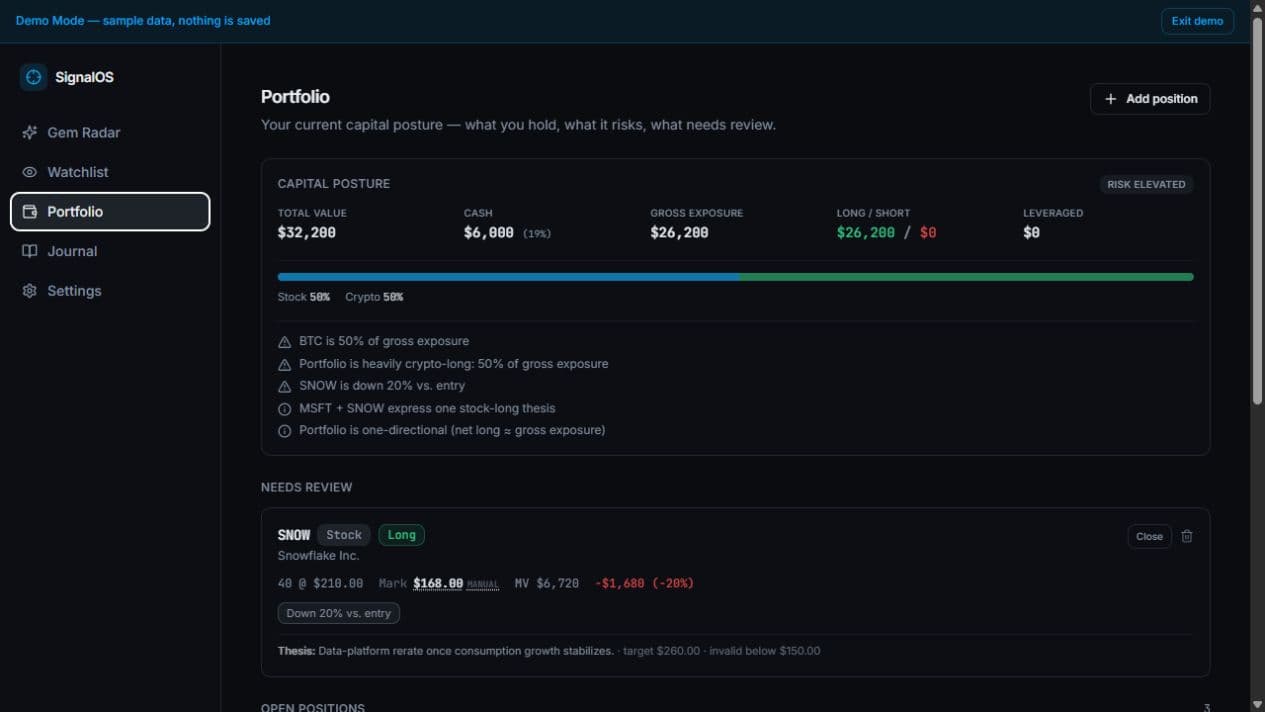
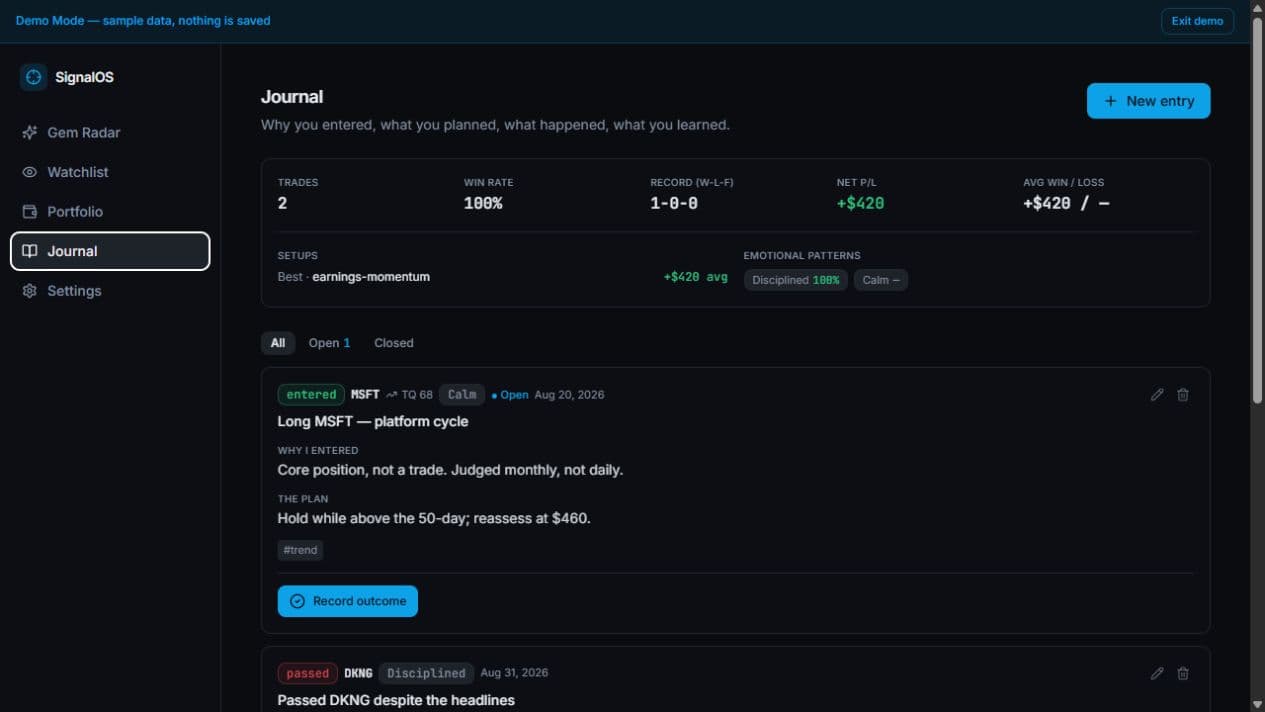
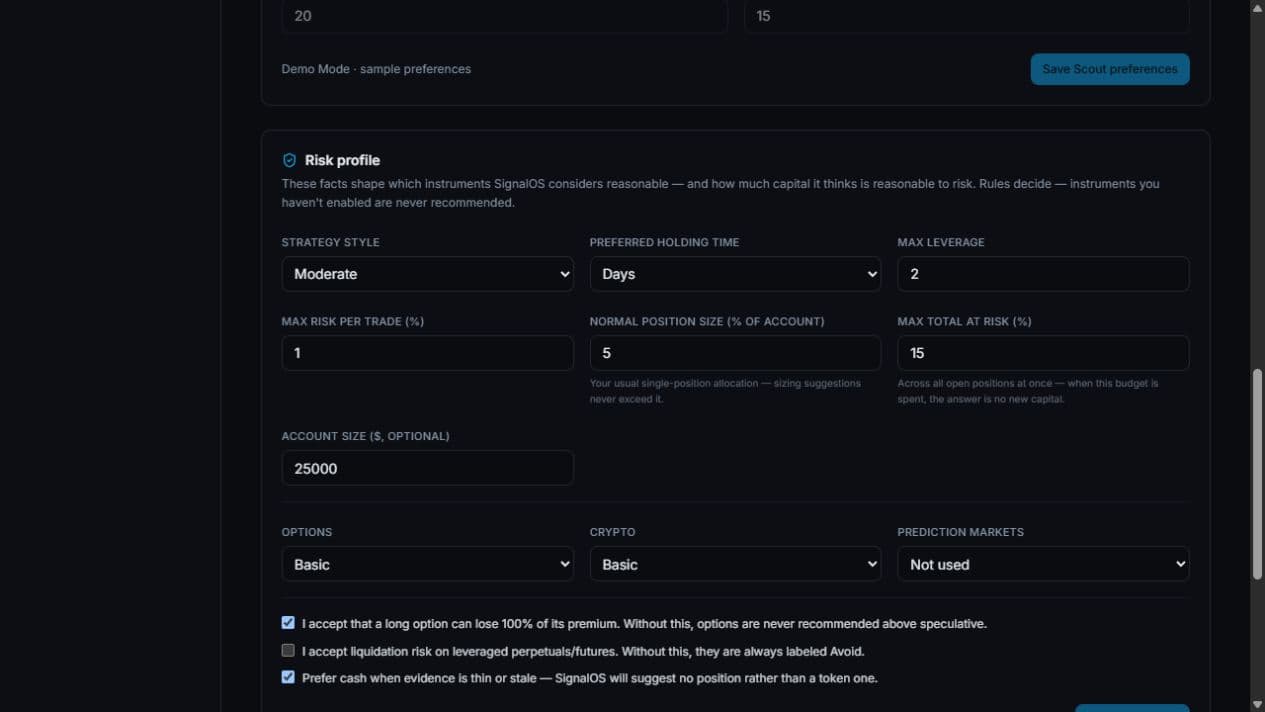
The current prototype explores this product model through watchlists, opportunity scoring, evidence panels, thesis summaries, bull and bear reasoning, portfolio context, and a decision journal.
Level of completion: an active browser-based prototype with implemented product flows and evolving evaluation logic.
Context
Many emerging AI products treat intelligence as a conversational layer added to an existing interface. The user asks a question, the model produces an answer, and the interaction ends with a confident block of text.
That pattern is convenient, but it is weak for consequential decisions.
Financial decisions require more than fluent language. They depend on evidence quality, conflicting signals, timing, uncertainty, personal exposure, and the cost of being wrong. A persuasive answer can feel useful even when the underlying reasoning is incomplete or unstable.
SignalOS responds to that problem by treating AI as one component inside a larger decision system.
The product asks a different set of questions:
- What evidence is actually available?
- Which signals are reliable enough to influence attention?
- What changed since the last review?
- Which risks remain unresolved?
- How does the opportunity relate to the user's existing portfolio or watchlist?
- What would invalidate the current thesis?
- Is action necessary, or is waiting the better decision?
This reframes the product from 'ask AI what to buy' to 'build a disciplined process for deciding what deserves attention.'
The product's use case is financial analysis, but the underlying interaction model applies more broadly to AI-assisted decision making in any domain where evidence, uncertainty, and accountability matter.
Challenge
The challenge was not getting AI to produce an answer. It was designing a system that made the reasoning inspectable before the answer could be trusted.
The central challenge was balancing speed with trust.
Users want fast answers because markets change quickly and attention is limited. But faster synthesis can also create false confidence. A model can produce a coherent thesis without revealing whether the underlying inputs were weak, stale, contradictory, or incomplete.
SignalOS therefore needed to support several competing goals:
- reduce the time required to review an opportunity;
- avoid presenting model output as objective truth;
- separate factual evidence from generated interpretation;
- make uncertainty visible without making the interface unusable;
- help users focus without hiding important counter-evidence;
- provide enough structure to improve consistency without pretending that judgment can be fully automated;
- preserve a record of why a decision was made;
- support 'No Trade Today' as a successful outcome.
The product also needed to avoid a common AI UX failure: using polished language to conceal weak system behavior.
The design problem became one of architecture rather than prompting. The interface had to show where information came from, how it was scored, which parts were deterministic, which parts were synthesized, and what remained unresolved.
My Role
SignalOS is a self-initiated product that I conceived, designed, prototyped, and developed as part of my AI product and decision-systems practice.
My responsibilities include:
- defining the product concept and core decision-support premise;
- framing the product around evidence, attention, judgment, and action;
- developing the 'Rules decide. AI explains.' architecture;
- designing the information hierarchy and primary interaction flows;
- defining watchlist, opportunity, thesis, evidence, verdict, and journal concepts;
- designing deterministic scoring approaches for attention and opportunity review;
- separating system-generated signals from LLM-generated explanation;
- prototyping the product in React, Vite, and TypeScript;
- implementing authentication and persistence using Supabase;
- integrating external market data and LLM synthesis;
- designing cached AI workflows to manage latency and repeated generation;
- refining the product through iterative browser-based testing;
- documenting product principles, feature logic, and future evaluation needs.
AI-assisted development tools were used throughout implementation and iteration. Product framing, interaction decisions, scoring logic, system boundaries, editorial direction, and final implementation choices remained directly authored.
No collaborators are currently confirmed for public credit.
Constraints
SignalOS operates in a domain where mistakes can have real consequences. That raises the trust cost of every interface decision.
The first constraint is model reliability. LLM output can be fluent while still being incomplete, overstated, or unsupported. The product cannot treat generated prose as a source of truth.
The second constraint is evidence quality. Market data may be delayed, missing, inconsistent, or too shallow to support a strong conclusion. Even a correct synthesis is only as useful as the inputs behind it.
The third constraint is latency. AI-generated analysis is slower and more expensive than deterministic interface logic. The product needs to remain responsive while making clear when synthesis is still loading, cached, stale, or unavailable.
The fourth constraint is evaluation. A decision-support system cannot be judged only by whether a trade later made money. Good decisions can produce bad outcomes, and bad decisions can occasionally produce gains. The product must therefore evaluate process quality separately from financial outcome.
The fifth constraint is user psychology. Financial interfaces can encourage overconfidence, urgency, and compulsive action. SignalOS needs to reduce noise and support restraint rather than optimizing for constant engagement.
Known constraint categories
- model hallucination and unsupported synthesis;
- delayed or incomplete market data;
- uncertainty about source quality;
- latency and API cost;
- cached versus current analysis;
- difficulty evaluating decision quality;
- risk of hindsight bias;
- risk of over-trusting a numerical score;
- user temptation to treat the product as financial advice;
- the need to distinguish evidence from interpretation;
- independent-project time and infrastructure limits.
Required product disclaimers
- SignalOS is a decision-support prototype.
- It is not financial advice.
- It does not guarantee outcomes.
- Users remain responsible for their own decisions.
Approach
I approached SignalOS as a system-design problem rather than a chatbot-design problem.
The process began by breaking a financial decision into smaller stages:
- collect signals and context;
- determine what deserves attention;
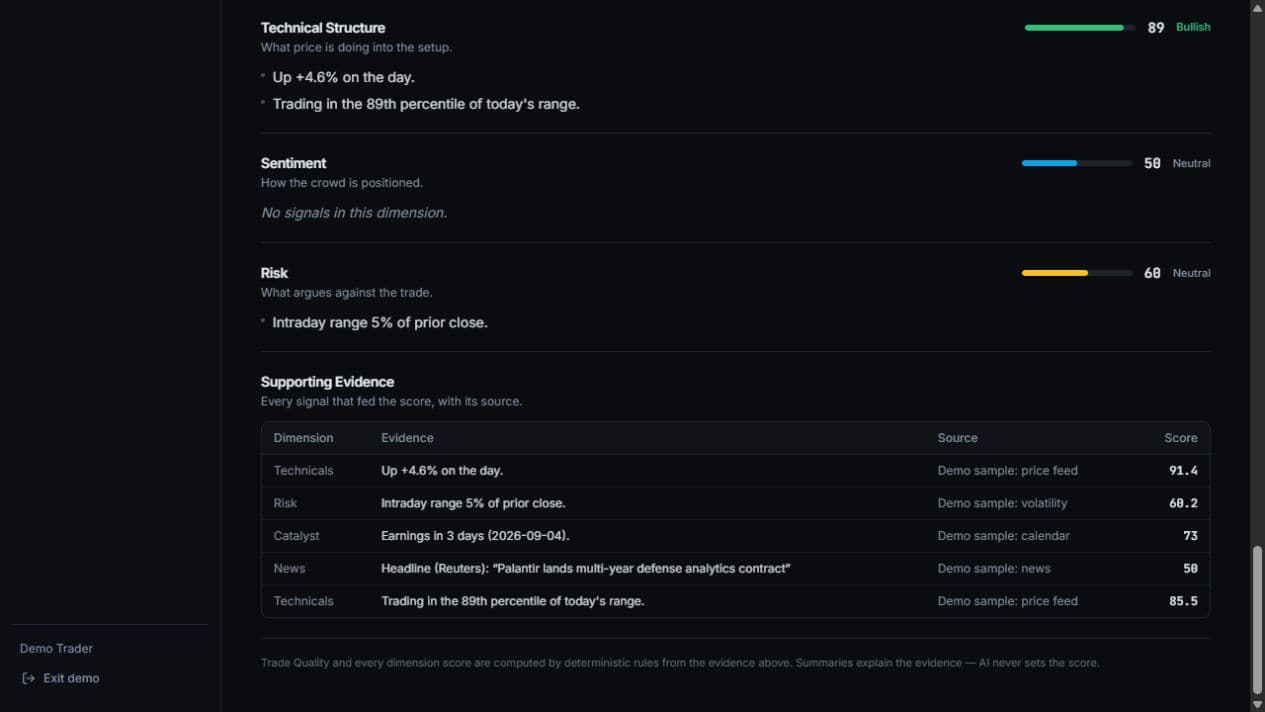
- organize supporting and conflicting evidence;
- form a provisional judgment;
- decide whether to act, wait, or reject the opportunity;
- record the reasoning for later review.
This structure became the foundation for the product architecture.
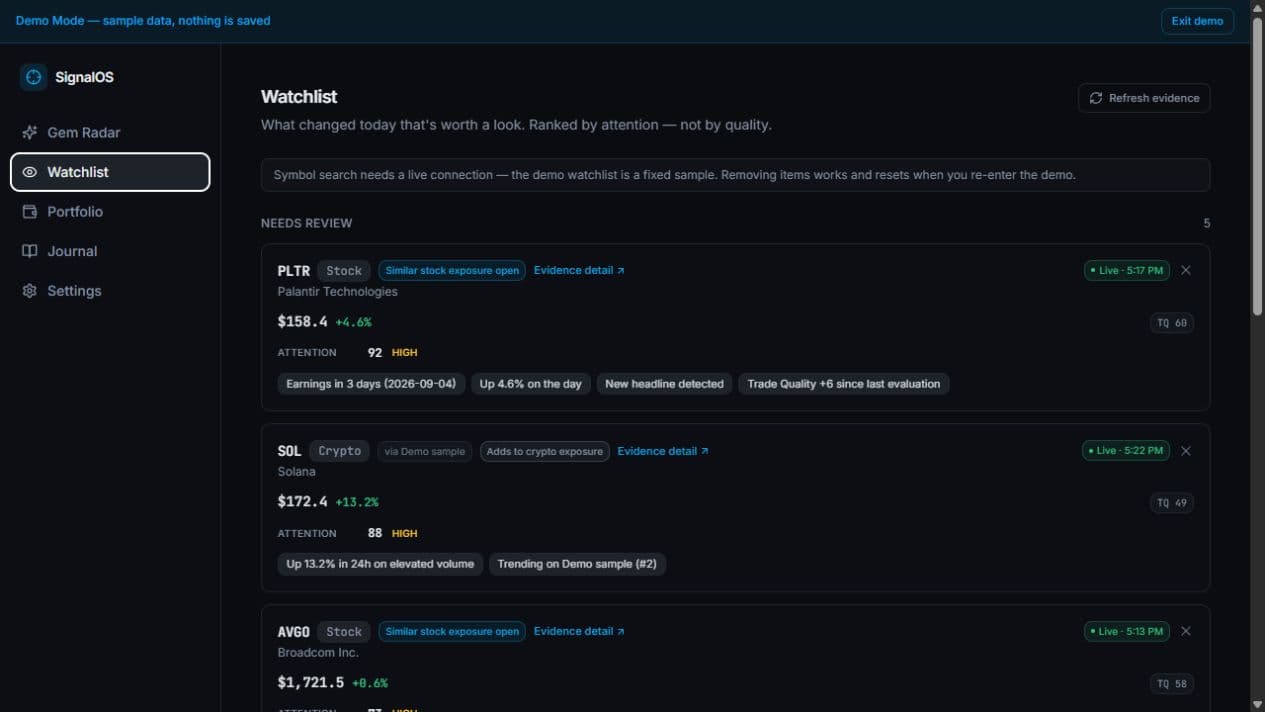
Early prototypes focused on watchlist attention. The goal was to prevent every asset from appearing equally urgent. Instead, the interface would identify meaningful changes and direct the user toward the opportunities most worthy of review.
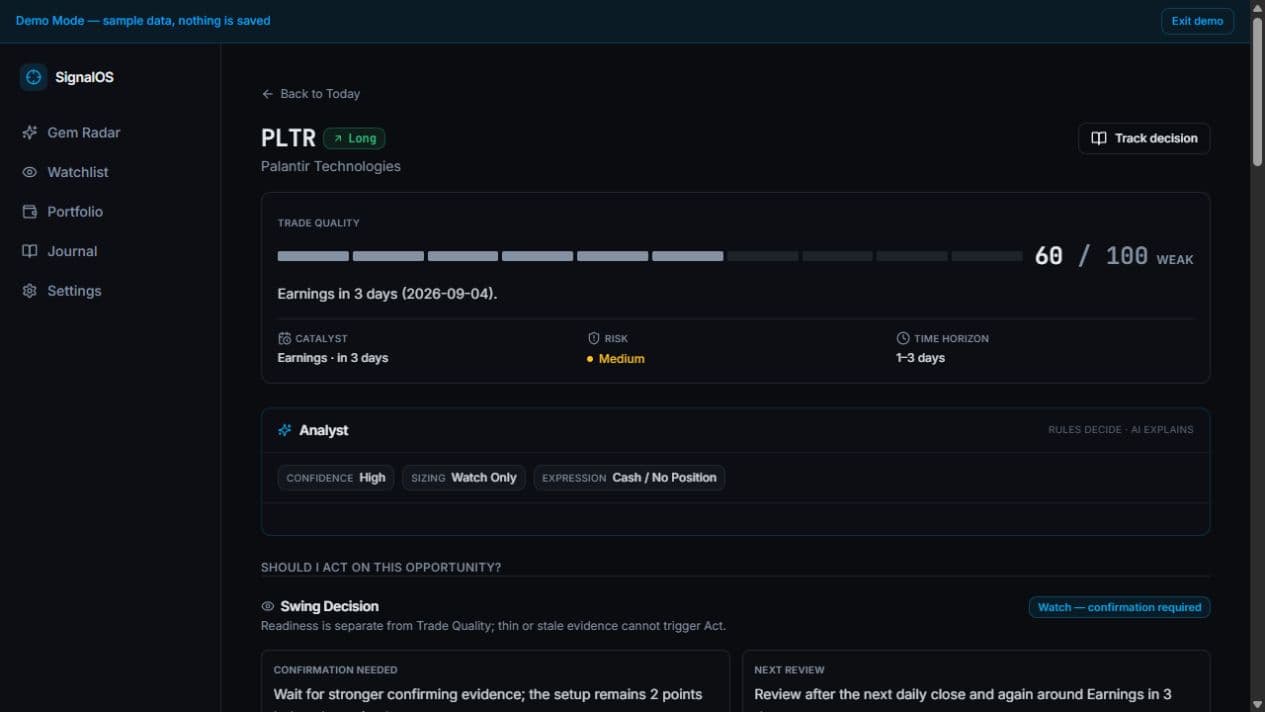
The next stage focused on the opportunity-detail experience. This page needed to combine quantitative scoring, evidence, AI-generated synthesis, portfolio context, risks, and decision history without collapsing everything into a single recommendation.
The product was then implemented as a working browser prototype using React, Vite, and TypeScript, with Supabase for authentication and persistence, external market-data integration, and Anthropic-powered synthesis.
The AI workflow was intentionally constrained. Deterministic logic produces scores and structured inputs. The model receives organized evidence and generates explanatory synthesis rather than deciding the score itself.
Evaluation remains ongoing. Current testing focuses on whether the interface:
- makes evidence easier to review;
- communicates uncertainty clearly;
- prevents AI prose from overpowering source information;
- helps users identify what changed;
- supports a deliberate 'no action' outcome;
- preserves enough context for later decision review.
The System
SignalOS is organized as an evidence-to-decision loop: signals enter the system, scoring directs attention, evidence supports judgment, AI explains the reasoning, and the user records a decision.
Rules decide. AI explains.
The product separates decision support into five layers.
1. Evidence Ingestion
Market data, watchlist changes, portfolio context, and user-provided information enter the system as structured inputs.
The purpose of this layer is not to create an answer. It is to establish what is known, what changed, and what may require review.
2. Attention Scoring
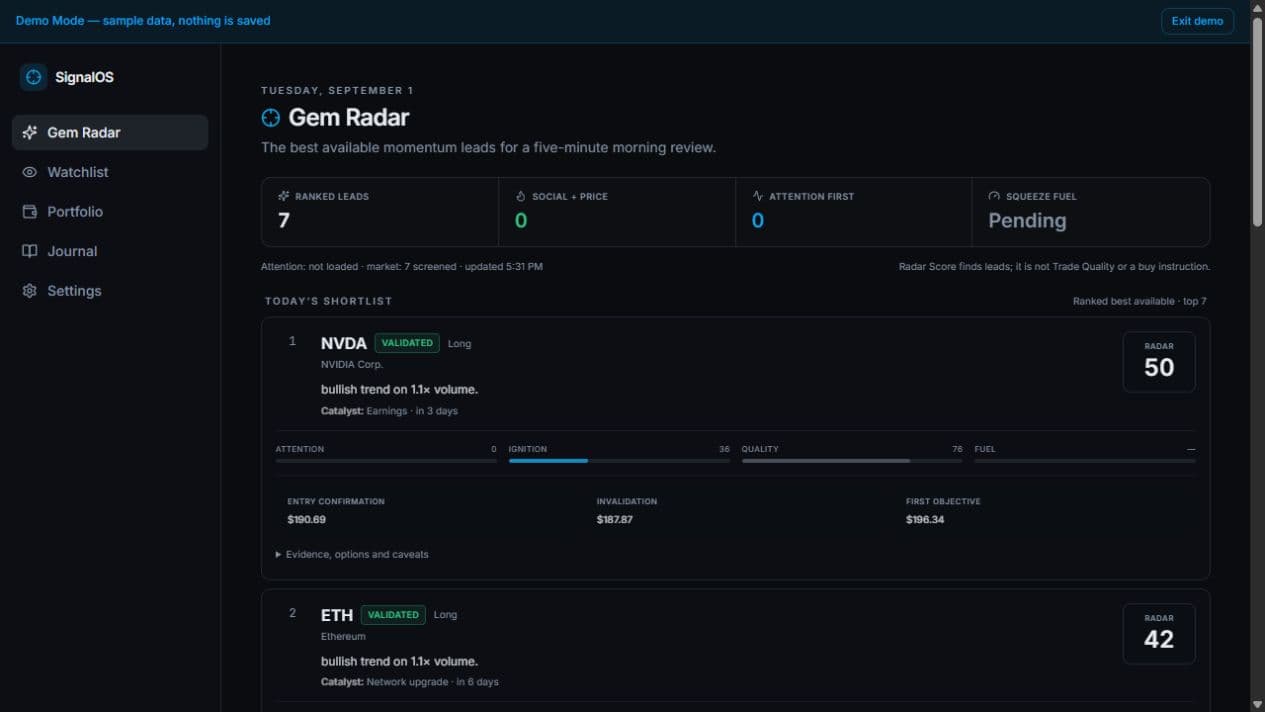
Deterministic logic evaluates which opportunities deserve attention.
The Watchlist Attention Score is intended to reduce noise by prioritizing meaningful changes rather than treating every movement as equally important.
This score is not a buy or sell recommendation. It is an attention-allocation mechanism.
3. Opportunity Evaluation
A separate opportunity view organizes the case for and against action.
This may include:
- current score or verdict state;
- supporting evidence;
- conflicting or risk evidence;
- portfolio exposure;
- thesis summary;
- bull case;
- bear case;
- invalidation conditions;
- unresolved questions;
- recent changes.
4. AI Synthesis
The LLM converts structured inputs into readable reasoning.
The model explains the evidence and tensions already present in the system. It does not independently create the deterministic score.
This separation allows the interface to distinguish source data, computed logic, generated interpretation, and user judgment.
5. Decision and Review
The user chooses whether to act, wait, reject, or continue investigating.
The decision journal preserves the thesis and surrounding context so the user can later evaluate the quality of the process rather than relying on memory or outcome alone.
Key Decisions
Separate scoring from AI explanation
- Chosen
Use deterministic logic for scoring and LLMs for synthesis and explanation.
- Tension
Allowing the model to generate the score directly would simplify the implementation and produce a more conversational experience, but it would make the basis of the decision harder to inspect or reproduce.
- Why
The separation makes the system more legible. Users can distinguish what was calculated from what was interpreted, and product behavior can be evaluated without relying on model phrasing.
- Affected
Architecture, trust model, prompt design, interface labeling, caching, debugging, and future evaluation.
Treat attention as a distinct product problem
- Chosen
Introduce a Watchlist Attention Score that determines what deserves review before any opportunity is framed as actionable.
- Tension
A conventional watchlist could display price changes and leave prioritization to the user, but that recreates the noise and scanning burden the product is meant to reduce.
- Why
Decision quality begins before judgment. If every signal competes equally for attention, users are more likely to react emotionally or spend time on weak opportunities.
- Affected
Watchlist hierarchy, notification logic, dashboard design, opportunity routing, and the meaning of urgency.
Make 'No Trade Today' a successful outcome
- Chosen
Design the product so waiting or rejecting an opportunity can be a valid final state.
- Tension
Many financial products encourage constant activity because engagement is easier to measure than restraint.
- Why
A decision-support system should improve decision quality, not maximize transactions. Avoiding an unsupported trade can be as valuable as identifying a strong one.
- Affected
Verdict states, language, success criteria, journal entries, user expectations, and product ethics.
Show counter-evidence beside the thesis
- Chosen
Present bull, bear, risk, and invalidation information as part of the primary opportunity view.
- Tension
A cleaner, more persuasive interface could emphasize only the dominant thesis, but that would increase confirmation bias.
- Why
Trustworthy decision support requires visible friction. The system should help users understand why the thesis might be wrong before they act.
- Affected
Information hierarchy, content density, AI synthesis schema, review behavior, and decision confidence.
Preserve reasoning in a journal
- Chosen
Record the evidence, thesis, and decision context for later review.
- Tension
Journaling adds friction to the decision process and may feel less immediate than a simple action button.
- Why
Without a record, users tend to reconstruct their reasoning after the outcome is known. Preserving the original context supports better reflection and reduces hindsight bias.
- Affected
Data persistence, decision flow, evaluation framework, user accountability, and longitudinal learning.
Artifacts and Interface
The current prototype is designed to make the system architecture visible through the interface.
The strongest artifacts should show how SignalOS moves from broad attention management to focused decision review.
The final case study should combine full interface captures with closer views of the product's evidence, synthesis, and decision states.
Outcome and Current Status
SignalOS currently exists as an active browser-based prototype that demonstrates the core product architecture.
The prototype establishes:
- a watchlist-oriented attention model;
- deterministic scoring logic;
- opportunity-detail views;
- structured evidence presentation;
- AI-generated thesis and explanatory synthesis;
- separation between scoring and AI interpretation;
- portfolio-aware context;
- persistent user accounts and data;
- a decision-journal concept;
- a product language that supports waiting or declining to act.
The project is not presented as a validated investment product, an autonomous trading system, or a source of financial advice.
Its current value is the product model it proves: AI can be more trustworthy when it is embedded inside a structured decision process rather than presented as a single authoritative answer.
The next stage is to evaluate the quality of the system more rigorously.
Potential next steps include:
- testing the scoring model against a larger range of scenarios;
- validating whether users understand the distinction between score and synthesis;
- improving source transparency and evidence freshness;
- adding clearer uncertainty and confidence states;
- refining cached versus current AI analysis;
- testing the journal as a tool for reducing hindsight bias;
- improving mobile and responsive behavior;
- strengthening accessibility;
- documenting technical architecture and prompt schemas;
- defining product-level evaluation criteria that measure decision process rather than only financial outcome.
Reflection
SignalOS changed the way I think about AI product design.
The most important design decision was not which model to use or how to phrase a prompt. It was deciding where AI should have authority and where it should not.
A model is useful at synthesis. It can organize complex inputs, surface tensions, and turn structured evidence into readable reasoning. But fluency is not the same as judgment, and explanation is not the same as truth.
That distinction led to the product's central principle: rules decide, AI explains.
The principle is intentionally imperfect. Deterministic rules can also be incomplete or poorly designed. But separating scoring from synthesis creates a system that can be inspected, tested, revised, and discussed. It gives users a clearer sense of what the product knows, what it inferred, and what remains their responsibility.
The project also reinforced that attention is a product surface.
Before users can make a good decision, they need help deciding what deserves review. The watchlist is therefore not just a list of assets. It is an attention-allocation system.
Finally, SignalOS clarified that a responsible decision-support product must be comfortable recommending restraint. 'No Trade Today' is not a failure state. It is evidence that the product is designed around decision quality rather than constant action.
Although SignalOS uses finance as its initial domain, the broader system points toward other consequential AI products: tools that curate evidence, manage attention, express uncertainty, preserve reasoning, and support accountable human judgment.