Memory Television
A CRT-based exploration platform for navigating personal memory, interactive artifacts, and authored digital worlds.
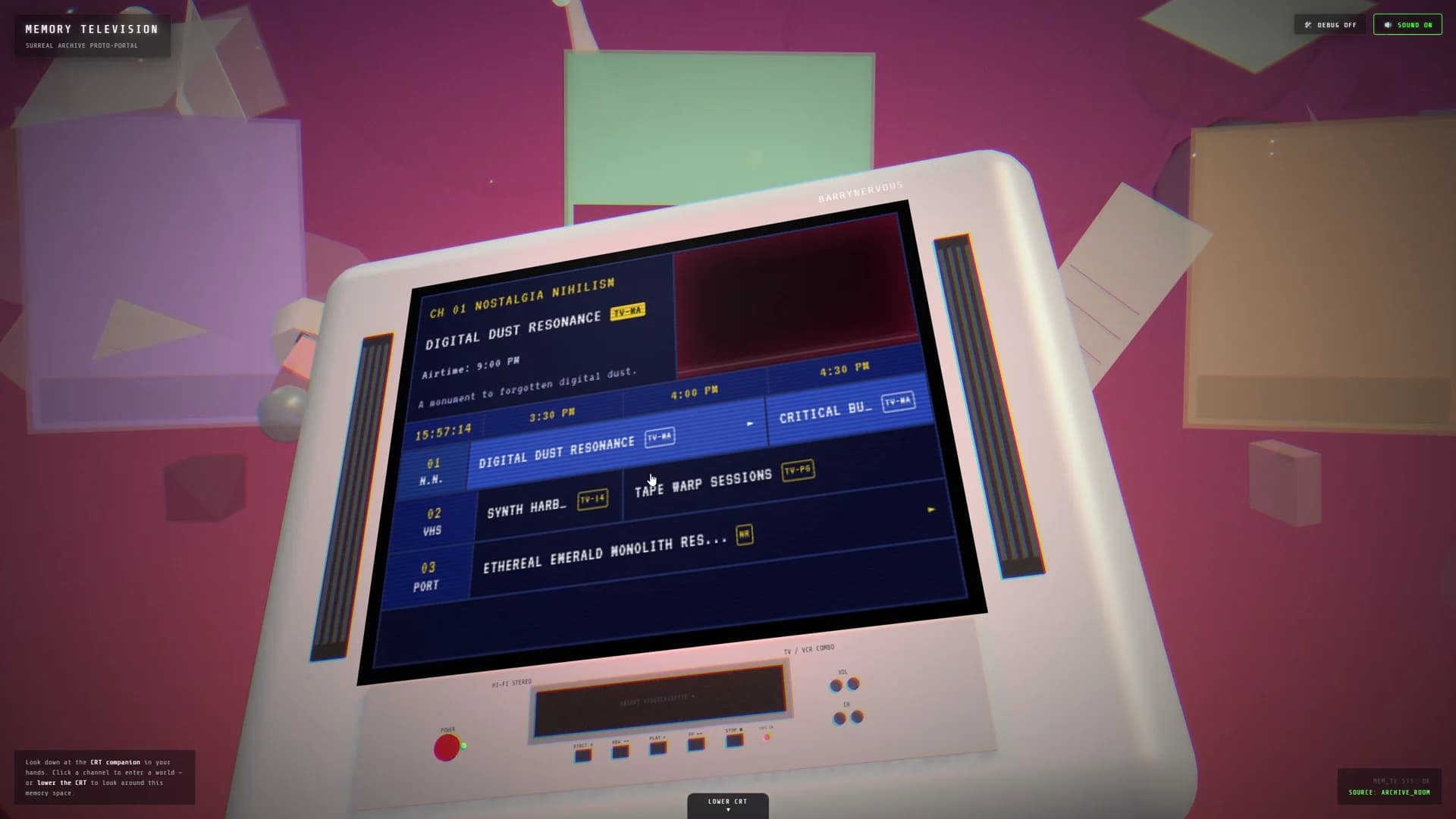
Memory Television is an experimental web experience that makes navigation part of the story. A handheld CRT-style device acts as an exploration companion, allowing visitors to move between channels, encounter interactive artifacts, and enter distinct memory worlds without relying on a conventional portfolio menu.
The project brings together immersive worldbuilding, interaction design, real-time media, and browser-based prototyping. It reflects a broader practice spanning creative technology, VR/XR, projection mapping, physical-digital installations, front-end development, and AI-assisted workflows.
Overview
Memory Television is an experimental interface for navigating a growing collection of digital worlds, personal archives, and creative projects.
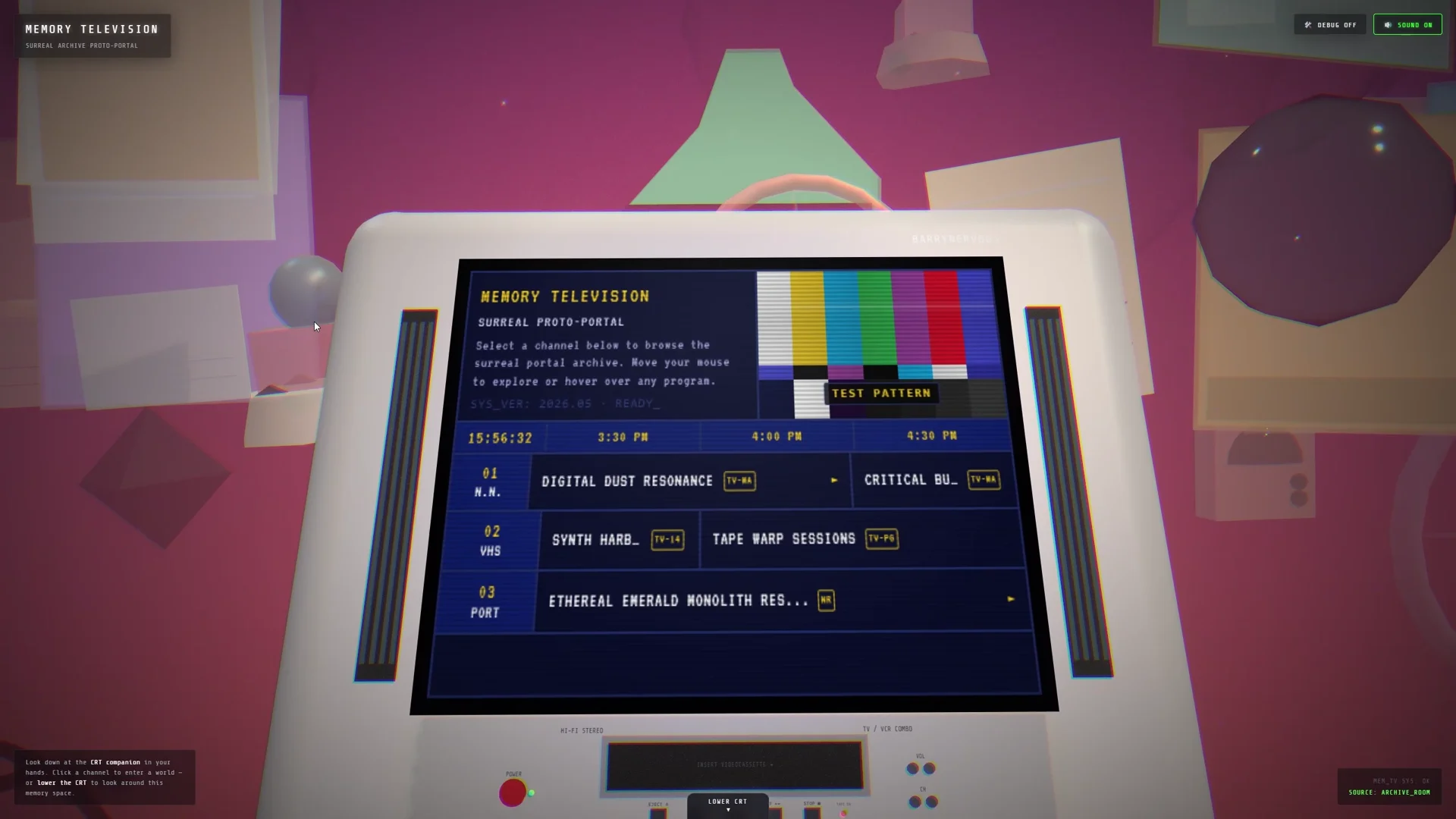
Instead of presenting the collection through a conventional portfolio menu, the experience gives the visitor a floating handheld CRT-style television. The device acts as both interface and narrative object: an exploration companion that allows the viewer to change channels, discover distinct worlds, and inspect artifacts within them.
The prototype is intended to establish a foundational interaction model for an expandable archive. Its purpose is not only to house my own projects, but to investigate how an artist's archive might feel when navigation itself becomes authored, physical, and emotionally specific.
Context
Memory Television began with a frustration I had with conventional portfolio structures. Grids, navigation bars, and project cards can communicate information clearly, but they rarely communicate how a body of work feels from the inside.
My practice moves between product design, software, music, immersive media, projection mapping, VR/XR, and experimental interaction. I wanted a container that could preserve those differences without flattening every project into the same visual format.
The project became an exploration of digital memory and navigation rituals. The CRT draws from consumer electronics, channel surfing, analog media, and the way certain technologies become inseparable from the memories they carried.
Rather than treating nostalgia as decoration, I wanted the television to become an active system. It mediates access to the archive, gives the experience a recognizable interaction language, and establishes an emotional tone before any individual world is entered.
The larger idea is that every artist's world could eventually have its own exploration companion. Mine happens to be a CRT. Another artist might use a camera, radio, map, scanner, handheld console, or an entirely different ritual for navigating their work.
Challenge
The challenge was not simply to design a menu. It was to invent a navigation ritual that belonged to the world.
The central challenge was making the interface understandable without reducing it to a conventional website placed inside a three-dimensional scene.
The television needed to perform several roles at once:
- provide clear navigation;
- feel physically present within the world;
- establish the project's visual identity;
- support multiple channels and future worlds;
- preserve a feeling of mystery and exploration;
- remain readable and controllable across browser-based interactions;
- avoid overwhelming the visitor with unnecessary movement or effects.
The interaction needed to balance atmosphere with usability. A completely unfamiliar interface could feel exciting but confusing. A familiar web menu would be easy to understand but would weaken the premise.
The design problem therefore became one of translation: how could familiar behaviors such as channel changing, selecting, focusing, and browsing be reinterpreted as part of an immersive memory device?
My Role
Memory Television is a self-initiated project that I conceived, designed, and developed as part of my creative technology practice.
My responsibilities include:
- defining the core concept and narrative premise;
- developing the exploration-companion interaction model;
- designing the handheld CRT device and its visual behavior;
- establishing the hubworld and channel structure;
- designing movement, hover, focus, and transition behaviors;
- defining the visual and emotional direction of the experience;
- prototyping the experience in the browser;
- implementing and refining interactive behavior;
- planning the broader system of channels, worlds, artifacts, and future artist-specific companions.
The project draws on a professional background that spans product and UX systems, front-end prototyping, immersive media, projection mapping, VR/XR, installation systems, and AI-assisted product development.
AI-assisted tools are part of the prototyping workflow, while concept definition, interaction decisions, visual direction, evaluation, and final implementation choices remain directly authored.
Constraints
The project is being developed as a browser-based immersive experience, which creates both creative opportunities and practical constraints.
The experience should remain accessible without specialized hardware or a downloadable application. That increases reach, but it requires careful attention to browser performance, loading time, input behavior, responsive layouts, legibility, and the range of devices visitors may use.
The television must remain readable while behaving like an object inside a spatial environment. Its movement needs to feel alive without making the interface difficult to control. Camera transitions need to communicate spatial movement without becoming disorienting.
The project also has an intentionally expandable structure. The system must eventually support additional channels, worlds, artifacts, and interaction patterns without requiring the entire hubworld or navigation model to be redesigned each time.
Because Memory Television remains an active prototype, some worlds may exist as planned channels rather than completed environments. The public case study must communicate future scale while remaining honest about what has already been built.
Known constraint categories
- real-time browser performance;
- text and interface legibility across screen sizes;
- atmospheric movement versus precise interaction;
- potential disorientation from spatial camera movement;
- mouse, touch, and future input support;
- modular expansion across multiple worlds;
- the time and production limits of an independent practice.
Approach
I began with the interaction object rather than the surrounding world.
The first question was not what the portfolio homepage should look like, but what a visitor should hold — or feel as though they were holding — while exploring it. The CRT emerged as a natural object because it connected memory, media, channels, consumer technology, and selective access.
From there, I developed the experience through iterative browser prototypes.
Early work focused on the television itself:
- its form and consumer-electronics character;
- how it should float or remain present in the environment;
- how much it should move while idle;
- how hovering should communicate availability;
- how channel changes should sound and feel;
- how the device should support navigation without dominating the world.
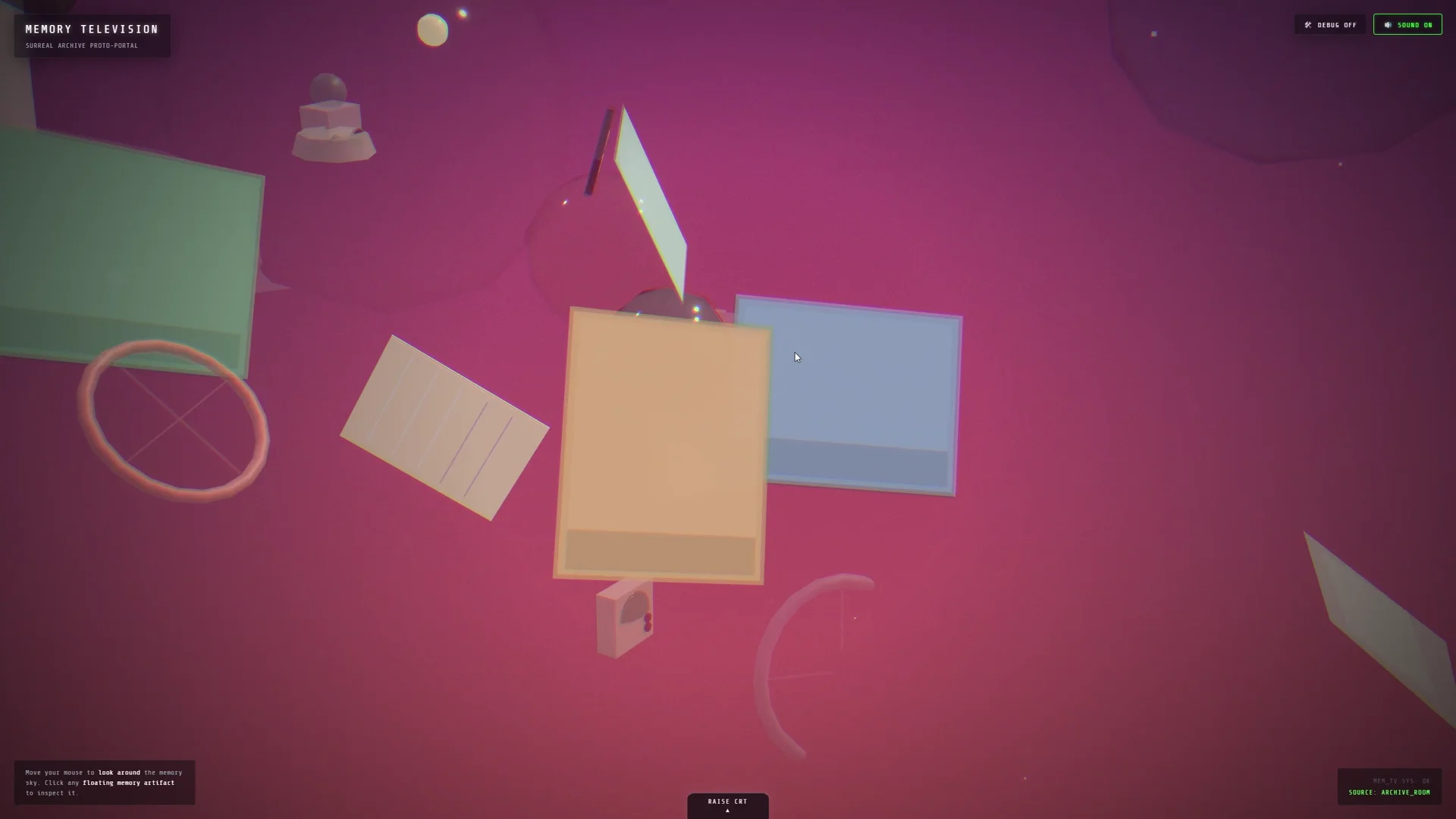
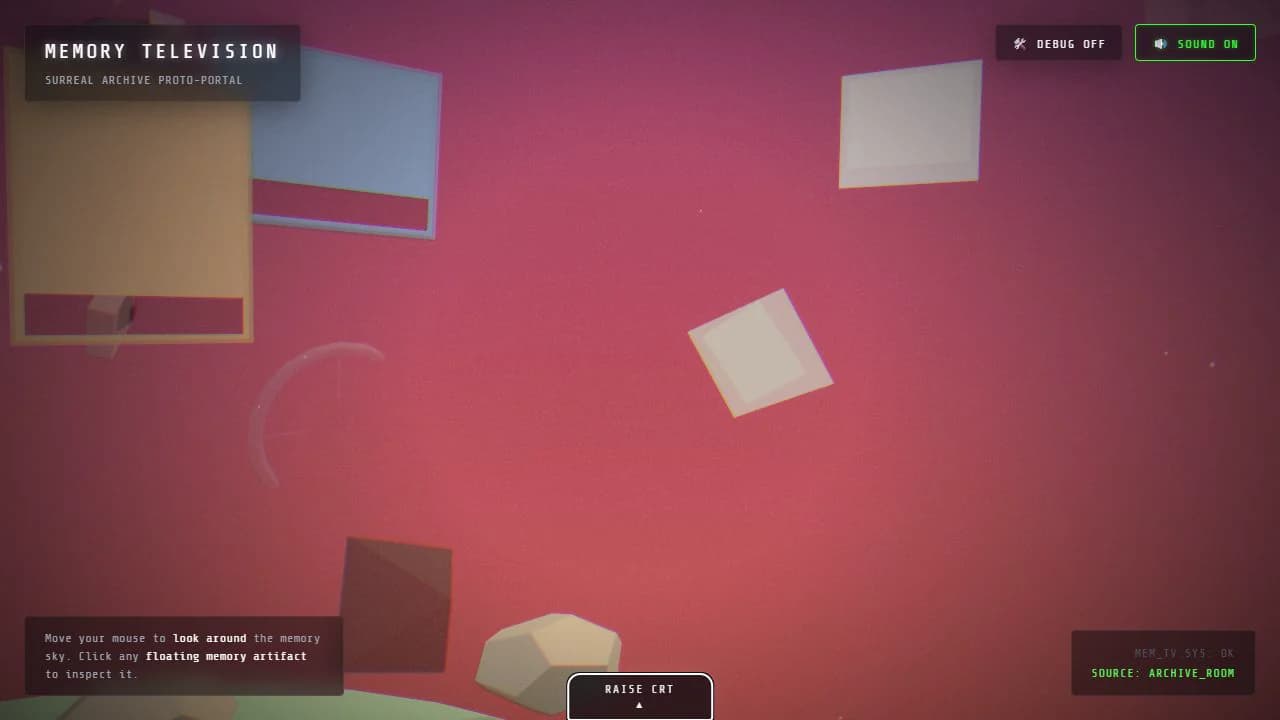
The next stage focused on the hubworld and the relationship between orientation and atmosphere. The goal was to make the hub feel less like a menu room and more like an impossible memory space.
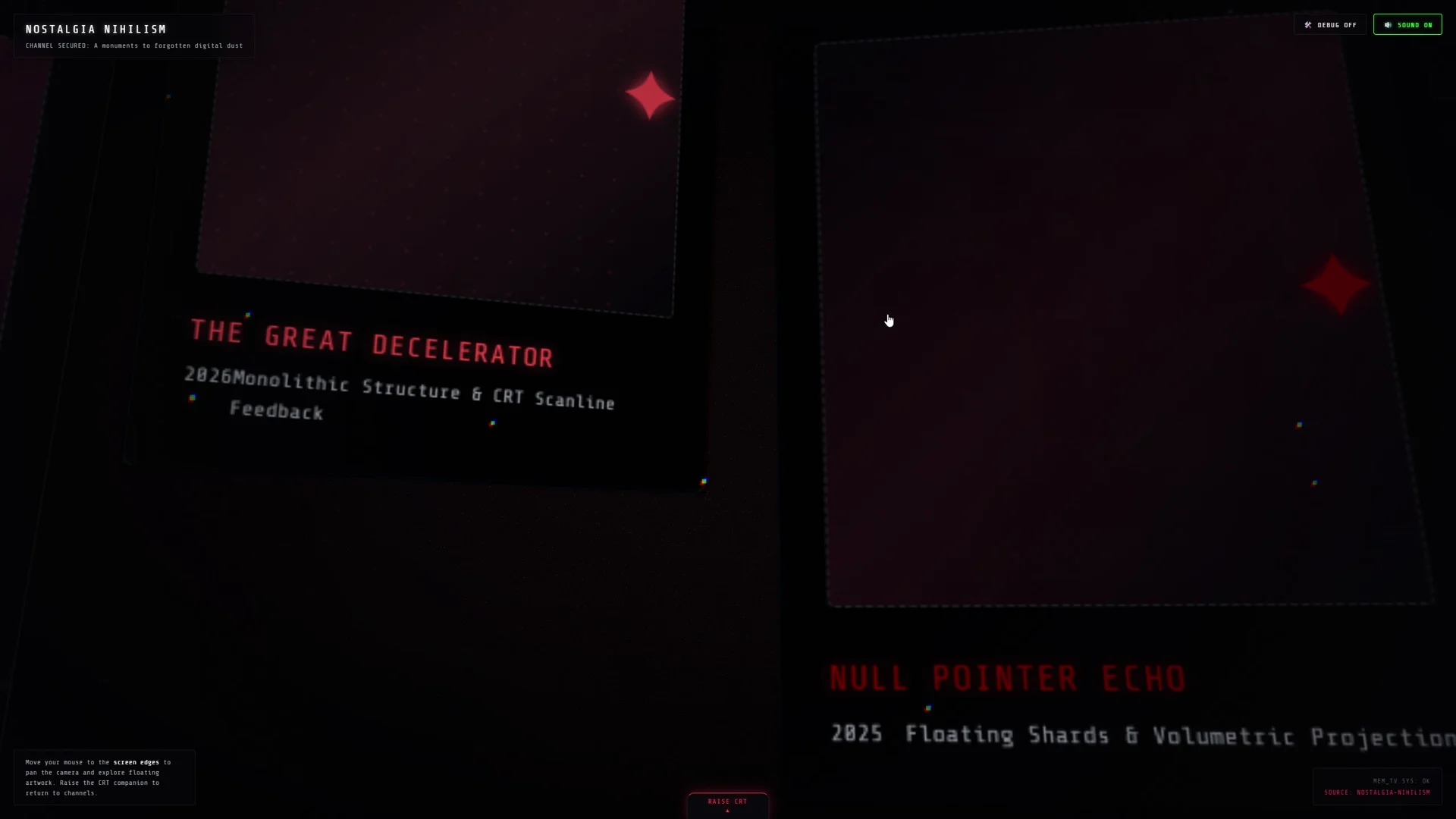
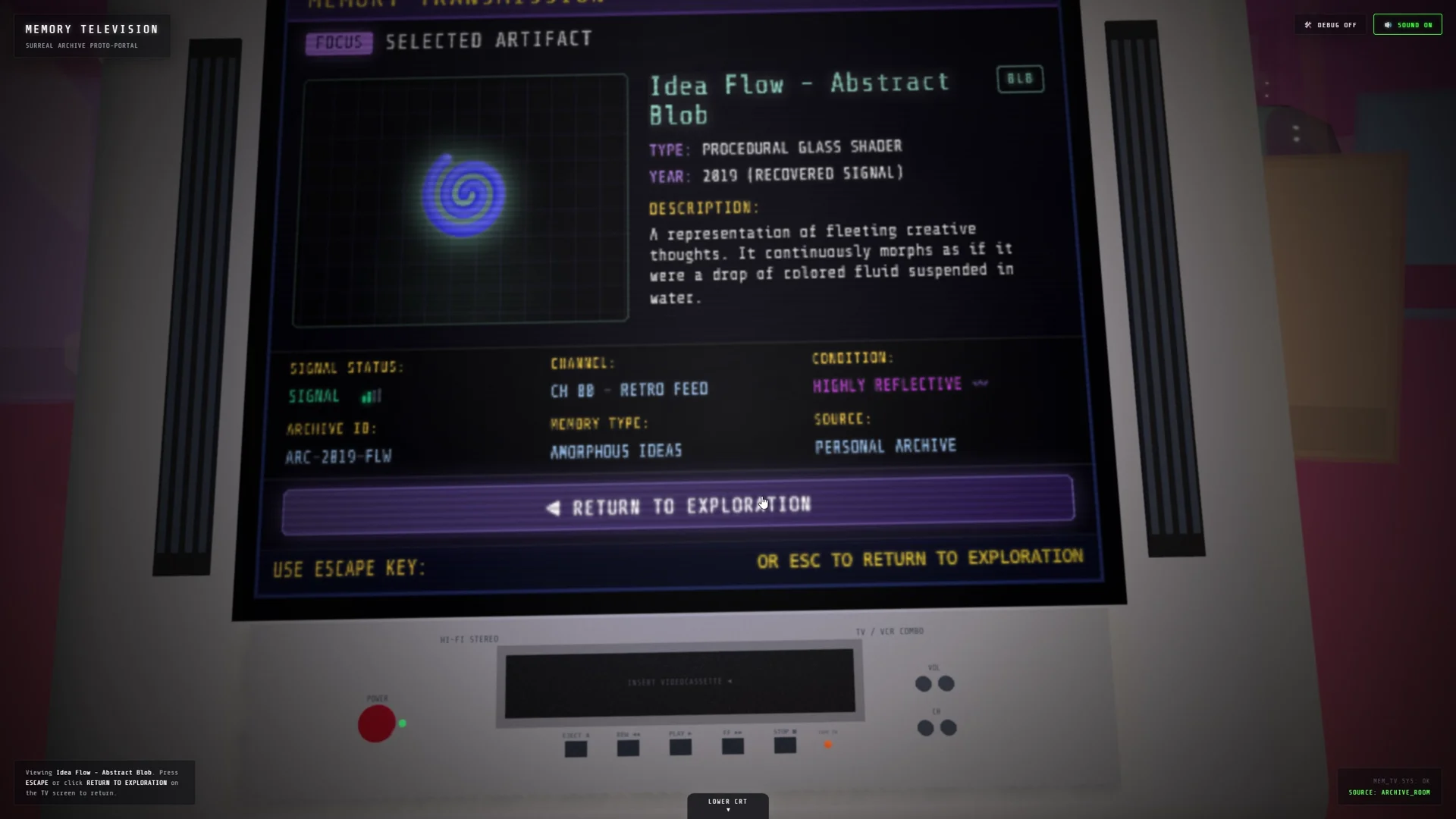
A further interaction state was developed for closer inspection of artifacts. This allows the visitor to shift from open exploration to focused attention without abandoning the surrounding spatial context entirely.
The process has been iterative rather than linear. Movement, camera behavior, hover treatments, sound cues, environmental tone, and transition pacing are refined through repeated testing in the browser.
The System
Memory Television is organized as a layered exploration system: the television provides access, the hubworld provides orientation, channels contain distinct worlds, and a focused inspection state supports closer attention to individual artifacts.
The handheld CRT is the primary interface and the project's central interaction language. It remains present as the visitor moves through the experience, acting as a bridge between the archive and the worlds it contains.
The proposed system is organized into four primary layers:
1. Exploration Companion
The CRT allows the visitor to browse channels and initiate transitions. It behaves like an object within the world rather than a flat navigation overlay, using restrained motion, hover feedback, and channel-change behavior to communicate its availability.
2. Hubworld
The hubworld is the spatial index of the experience. It provides orientation and a broader view of available memories, artifacts, and destinations.
3. Channels and Worlds
Each channel represents a distinct authored world or archive. Every world can establish its own imagery, atmosphere, artifacts, sound, and interaction rules while remaining connected through the television.
[Needs verification: confirm final channel names and which channels are currently functional before listing them publicly.]
4. Focused Inspection
A focused interaction state supports closer examination of selected artifacts. The visitor remains within the world, but surrounding information is reduced so attention can temporarily narrow around the chosen object.
[Needs verification: confirm whether the public feature name is 'Focus Mode', and document its current behavior before publishing detailed timing or transition claims.]
Key Decisions
Make the interface an object within the world
- Chosen
Use a floating handheld CRT as the primary navigation system rather than placing conventional menus over the experience.
- Tension
A standard navigation bar would be immediately understandable, but it would separate the interface from the project's emotional and spatial premise.
- Why
The television connects navigation, memory, media history, and worldbuilding within one recognizable object. It allows the interface itself to carry meaning.
- Affected
Visual identity, interaction model, channel navigation, sound, camera composition, and the future exploration-companion framework.
Avoid fixed embodiment
- Chosen
Present the CRT without requiring a fully rendered body or conventional first-person controller.
- Tension
Visible hands or a body could make the object feel more physically grounded, but they would introduce animation complexity, embodiment assumptions, and additional visual distraction.
- Why
A less literal presentation allows visitors to project themselves into the experience while keeping attention on the device and surrounding world. It also supports the project's slightly impossible, dreamlike quality.
- Affected
Device movement, spatial presence, camera framing, interaction feedback, and tone.
[Needs verification: confirm the final implementation before presenting this as a completed interaction decision.]
Separate exploration from inspection
- Chosen
Use a distinct interaction state for viewing individual artifacts.
- Tension
Examining every artifact directly from the general navigation view would simplify the system, but detailed content could become harder to read and the sense of intentional attention would weaken.
- Why
A dedicated inspection state creates a clear shift from wandering to examining while keeping the visitor inside the world.
- Affected
Camera transitions, artifact interaction, content legibility, attention hierarchy, and reusable world components.
Use channel-based structure instead of a project grid
- Chosen
Organize distinct bodies of work as channels accessed through the television.
- Tension
A project grid would expose all content immediately, while channels ask the visitor to explore and discover.
- Why
Channels create continuity between the CRT object and the archive structure. They also allow each body of work to maintain its own visual and narrative identity.
- Affected
Information architecture, naming, navigation, future scalability, and world differentiation.
Artifacts and Interface
The current prototype focuses on proving the central interaction language rather than completing every planned channel.
The most important artifacts are therefore the pieces that establish how the system feels:
- the CRT exploration companion;
- the hubworld;
- channel-selection behavior;
- the movement model;
- the transition from exploration to inspection;
- the visual treatment of interactive artifacts;
- the reusable logic that allows objects across different worlds to behave consistently.
The final case study should combine atmospheric views with clear interaction evidence. Full-frame world captures can communicate tone, while paired frames and short recordings can explain how the interface changes between exploration, navigation, and inspection.
Outcome and Current Status
Memory Television currently exists as an active browser-based prototype that establishes the project's core direction: a CRT exploration companion, a spatial hub, channel-based navigation, interactive artifacts, and a framework for authored worlds.
The project is not presented as a finished platform. Its current value is the working interaction premise and the design system it establishes for future development.
The next stage is to deepen the prototype with real archive content, complete the initial worlds, refine interaction transitions, test responsive behavior, improve accessibility and performance, and document the system through current screenshots and recordings.
The longer-term possibility is larger than a single personal portfolio. Memory Television proposes a framework in which artists can build explorable worlds using companions and interaction rituals specific to their own practices.
The CRT is my companion. The larger system asks what another artist might choose to carry.
Reflection
Memory Television changed the way I think about navigation.
I began the project believing I was designing a more interesting container for my work. What emerged was a broader question about how interfaces shape our relationship to memory, authorship, and attention.
Most digital archives treat navigation as neutral infrastructure. The menu exists outside the content and is expected to disappear once it has done its job. Memory Television takes the opposite position: the method of access is part of the meaning.
The television affects how the visitor approaches every world behind it. It introduces slowness, selection, distance, and ritual. It asks the visitor to tune into something rather than merely click it.
The project also reinforced my interest in creating systems that are both functional and authored. I do not want experimentation to mean abandoning usability, and I do not want usability to require removing personality. The most interesting interaction often exists in the negotiation between those priorities.
Memory Television remains unfinished, but that incompleteness is appropriate to the idea. Memory is never a complete archive. It changes depending on where we stand, what we choose to revisit, and what device we use to reach it.